你好! Shipping to Taiwan with premium packaging for just NT$300 

Ship to
Taiwan
0
  • argentina
  • chile
  • colombia
  • españa
  • méxico
  • perú
  • estados unidos
  • internacional

Select your country

Americas

Europe

Rest of the world

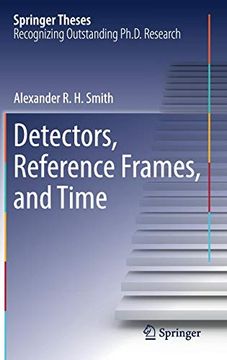
portada Detectors, Reference Frames, and Time (Springer Theses)
Type
Physical Book
Publisher
Year
2019
Language
English
Pages
167
Format
Hardcover
ISBN13
9783030109998
Edition No.
1

Detectors, Reference Frames, and Time (Springer Theses)

Alexander R. H. Smith (Author) · Springer · Hardcover

Detectors, Reference Frames, and Time (Springer Theses) - Alexander R. H. Smith

Cheaper New Book Imported to Taiwan
Delivery: 07 Oct - 20 Oct Shipping: 13 to 17 business days.
NT$ 3,364
Faster New Book Imported to Taiwan
Delivery: 28 Sep - 06 Oct Shipping: 6 to 7 business days.
NT$ 4,611
NT$ 3,364

Synopsis "Detectors, Reference Frames, and Time (Springer Theses) "

This thesis uses the tools of quantum information science to uncover fascinating new insights about the intersection of quantum theory and relativity. It is divided into three self-contained parts, the first of which employs detector models to investigate how the information content of quantum fields depends on spacetime curvature and global spacetime topology. The behavior of Unruh-DeWitt detectors on curved spacetimes are investigated, following which these detectors are used to probe the vacuum state of a scalar field in various topologies. This leads to a generalization of the entanglement harvesting protocol involving detectors in arbitrary curved spacetimes admitting a Wightman function. The second part extends the theory of quantum reference frames to those associated with noncompact groups. Motivated by the pursuit of a relational relativistic quantum theory where the group of reference frames is the Poincaré group, the author then generalizes a communication protocol between two parties lacking a common reference frame to the scenario where the group of transformations of their reference frame is a one-dimensional noncompact Lie group. Finally, the third part, inspired by theories of quantum gravity, generalizes the conditional probability interpretation of time, a proposed mechanism for time to emerge from a fundamentally timeless Universe. While the conditional probability interpretation of time is based upon conditioning a solution to the Wheeler-DeWitt equation on a subsystem of the universe that acts a clock, the author extends this approach to include an interaction between the system being used as a clock and a system whose evolution the clock is tracking.  

Customers reviews

Frequently Asked Questions about the Book

All books in our catalog are Original.
The book is written in English.
The binding of this edition is Hardcover.

Questions and Answers about the Book

Do you have a question about the book? Login to be able to add your own question.

Opinions about Bookdelivery

More customer reviews