你好! Shipping to Taiwan with premium packaging for just NT$300 

Ship to
Taiwan
0
  • argentina
  • chile
  • colombia
  • españa
  • méxico
  • perú
  • estados unidos
  • internacional

Select your country

Americas

Europe

Rest of the world

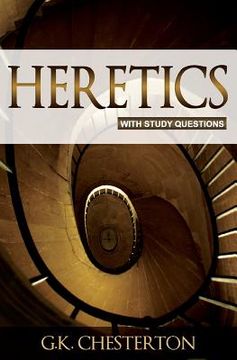
portada Heretics: with Study Questions
Type
Physical Book
Language
English
Pages
218
Format
Paperback
Dimensions
20.3x13.3x1.2 cm
Weight
0.23 kg.
ISBN13
9781947935037

Heretics: with Study Questions

G. K. Chesterton (Author) · Thebiblepeople.com · Paperback

Heretics: with Study Questions - G. K. Chesterton

New Book Imported to Taiwan
Delivery: 14 Oct - 27 Oct Shipping: 16 to 20 business days.
NT$ 674
NT$ 674

Synopsis "Heretics: with Study Questions"

Chesterton's No-Holds-Barred Critique of Man-Centered Philosophy!"We direly need another Chesterton today. ... In a time when culture and faith have drifted even further apart, we could use his brilliance, his entertaining style, and above all his generous and joyful spirit." author Philip Yancey.The companion to G.K. Chesterton's classic Christian book, Orthodoxy.What if abook published in 1905 held the key to understanding today's debates about God, atheism, relativism and philosophy?Are you confused (and perhaps challenged) by the philosophical and religious debates of our time?Do you need help knowing how to discuss religion and philosophy with your nextdoor neighbor?Do you want to better understand the world's beliefs through the wit and wisdom of one of Christianity's greatest writers?G.K. Chesterton's Heretics is for anyone who wants to broaden their understanding of philosophy while staying grounded in God's Word. G.K. Chesterton wrote Heretics in the early 1900s to address what he considered the heresies of his day, but it soon was overshadowed by his follow-up classic book, Orthodoxy (1908). Chesterton, though, considered the two books companion pieces.Heretics is as relevant today as it was a century ago.In Heretics, Chesterton: Confronts the heresies of his day with his trademark no-holding-back wit: "In former days the heretic was proud of not being a heretic," he writes, asserting that "heresy" was no longer taboo. "All this can mean one thing, and one thing only. It means that people care less for whether they are philosophically right. For obviously a man ought to confess himself crazy before he confesses himself heretical."Critiques, by name, the heretics of his day. Among them: H.G. Wells, Bernard Shaw, and Lowes Dickinson. Wells believed "that there are no secure and reliable ideas upon which we can rest." Shaw taught that the "golden rule is that there is no golden rule." Dickinson was a "provocative" supporter of paganism. Chesterton wrote, "The most practical and important thing about a man is still his view of the universe."Explains his belief in Christianity, in typical Chesterton style. "All the empires and the kingdoms [of the world] have failed, because ... they were founded by strong men and upon strong men. But this one thing, the historic Christian Church, was founded on a weak man, and for that reason it is indestructible. For no chain is stronger than its weakest link."Chesterton refutes relativism, rationalism, paganism and other man-centered philosophies that were popular during his day -- philosophies that may be even more trendy and prominent in our modern world.Scroll up to buy and find out why C.S. Lewis himself called Chesterton one of the greatest apologists of his time!
G. K. Chesterton
  (Author)
View Author's Page
G. K. Chesterton (London, May 29, 1874 – Beaconsfield, June 14, 1936) was a prolific British writer, author of essays, novels, poetry, biographies, and Christian apologetics. His work is characterized by irony, paradoxical wit, and a critical view of modernity. He was a prominent convert to Catholicism and an influential figure in religious and literary thought of his time. He is also known for his brilliant argumentative style and his defense of common sense.

Among his most recognized works are The Man Who Was Thursday (1908), Orthodoxy (1908), The Innocence of Father Brown (1911), Heretics (1905), The Ball and the Cross (1909), and The Resurrection of Rome (1930). He cultivated the essay, the novel of ideas, detective stories, and social and religious criticism.
See more
See less

Customers reviews

Frequently Asked Questions about the Book

All books in our catalog are Original.
The book is written in English.
The binding of this edition is Paperback.

Questions and Answers about the Book

Do you have a question about the book? Login to be able to add your own question.

Opinions about Bookdelivery

More customer reviews