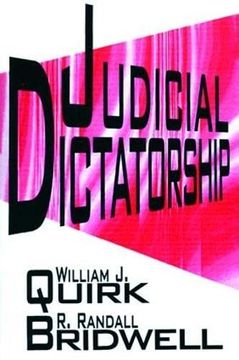
American society has undergone a revolution within a revolution. Until the 1960s, America was a liberal country in the traditional sense of legislative and executive checks and balances. Since then, the Supreme Court has taken on the role of the protector of individual rights against the will of the majority by creating, in a series of decisions, new rights for criminal defendants, atheists, homosexuals, illegal aliens, and others. Repeatedly, on a variety of cases, the Court has overturned the actions of local police or state laws under which local officials are acting. The result, according to Quirk and Birdwell, is freedom for the lawless and oppression for the law abiding. 'Judicial Dictatorship' challenges the status quo, arguing that in many respects the Supreme Court has assumed authority far beyond the original intent of the Founding Fathers. In order to avoid abuse of power, the three branches of the American government were designed to operate under a system of checks and balances. However, this balance has been upset. The Supreme Court has become the ultimate arbiter in the legal system through exercise of the doctrine of judicial review, which allows the court to invalidate any state or federal law it considers inconsistent with the constitution. Supporters of judicial review believe that there has to be a final arbiter of constitutional interpretation, and the Judiciary is the most suitable choice. Opponents, Thomas Jefferson and Abraham Lincoln among them, believed that judicial review assumes the judicial branch is above the other branches, a result the Constitution did not intend. The democratic paradox is that the majority in America agreed to limit its own power. Jefferson believed that the will of the majority must always prevail. His faith in the common man led him to advocate a weak national government, one that derived its power from the people. Alexander Hamilton, often Jefferson's adversary, lacking such faith, feared "the amazing violence and turbulence of the democratic spirit." This led him to believe in a strong national government, a social and economic aristocracy, and finally, judicial review. This conflict has yet to be resolved. 'Judicial Dictatorship' discusses the issue of who will decide if government has gone beyond its proper powers. That issue, in turn, depends on whether the Jeffersonian or Hamiltonian view of the nature of the person prevails. In challenging customary ideological alignments of conservative and liberal doctrine, 'Judicial Dictatorship' will be of interest to students and professionals in law, political scientists, and those interested in U.S. history.