你好! Shipping to Taiwan with premium packaging for just NT$300 

Ship to
Taiwan
0
  • argentina
  • chile
  • colombia
  • españa
  • méxico
  • perú
  • estados unidos
  • internacional

Select your country

Americas

Europe

Rest of the world

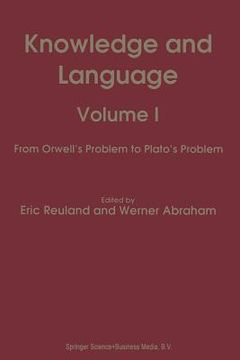
portada Knowledge and Language: Volume I from Orwell's Problem to Plato's Problem
Type
Physical Book
Publisher
Language
English
Pages
272
Format
Paperback
Dimensions
23.4x15.6x1.5 cm
Weight
0.40 kg.
ISBN13
9789401048125

Knowledge and Language: Volume I from Orwell's Problem to Plato's Problem

Reuland, E. ; Abraham, W. (Author) · Springer · Paperback

Knowledge and Language: Volume I from Orwell's Problem to Plato's Problem - Reuland, E. ; Abraham, W.

Cheaper New Book Imported to Taiwan
Delivery: 03 Dec - 16 Dec Shipping: 14 to 18 business days.
NT$ 1,898
Faster New Book Imported to Taiwan
Delivery: 20 Nov - 30 Nov Shipping: 5 to 6 business days.
NT$ 2,415
NT$ 1,898

Synopsis "Knowledge and Language: Volume I from Orwell's Problem to Plato's Problem"

1. BACKGROUND This volume is one of three which emerged from the Conference on Knowledge and Language, held from May 21-May 25, 1989, at the occasion of the 37 5th anniversary of the University of Groningen. Studying the relation between knowledge and language, one may distin- guish two different lines of inquiry, one focussing on language as a body of knowledge, the other on language as a vehicle of knowledge. Approaching language as a body of knowledge one faces questions concerning its structure, and the relation with other types of knowledge. One will ask, then, how language is acquired and to what extent the acquisition of language and the structure of the language faculty model relevant aspects of other cognitive capacities. If language is approached as a vehicle for knowledge, the question comes up what enables linguistic entities to represent facts about the world. To what extent does this rely on conventional aspects of meaning? Is it possible for language, when used non-conventionally as in metaphors, to convey intersubjective knowledge? If so (and it does seem to be the case), one may wonder what makes this possible. The aim of this conference was to investigate the role of conceptual structure in cognitive processes, exploring it from the perspectives of philosophy of language, linguistics, political philosophy, psychology, liter- ary theory, aesthetics, and the philosophy of science. The themes of these three volumes reflect the themes of the conference.

Customers reviews

Frequently Asked Questions about the Book

All books in our catalog are Original.
The book is written in English.
The binding of this edition is Paperback.

Questions and Answers about the Book

Do you have a question about the book? Login to be able to add your own question.

Opinions about Bookdelivery

More customer reviews