你好! Tracked shipping to Taiwan with premium packaging for just NT$300 

Ship to
Taiwan
0
  • argentina
  • chile
  • colombia
  • españa
  • méxico
  • perú
  • estados unidos
  • internacional

Select your country

Americas

Europe

Rest of the world

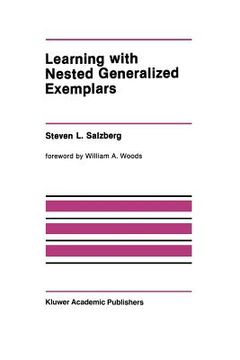
portada Learning with Nested Generalized Exemplars
Type
Physical Book
Publisher
Language
English
Pages
160
Format
Paperback
Dimensions
23.4 x 15.6 x 1.0 cm
Weight
0.27 kg.
ISBN13
9781461288305

Learning with Nested Generalized Exemplars

Steven L. Salzberg (Author) · Springer · Paperback

Learning with Nested Generalized Exemplars - Salzberg, Steven L.

Cheaper New Book Imported to Taiwan
Delivery: 02 Sep - 15 Sep Shipping: 13 to 17 business days.
NT$ 3,414
Faster New Book Imported to Taiwan
Delivery: 20 Aug - 28 Aug Shipping: 5 to 6 business days.
NT$ 4,618
NT$ 3,414

Synopsis "Learning with Nested Generalized Exemplars"

Machine Learning is one of the oldest and most intriguing areas of Ar- tificial Intelligence. From the moment that computer visionaries first began to conceive the potential for general-purpose symbolic computa- tion, the concept of a machine that could learn by itself has been an ever present goal. Today, although there have been many implemented com- puter programs that can be said to learn, we are still far from achieving the lofty visions of self-organizing automata that spring to mind when we think of machine learning. We have established some base camps and scaled some of the foothills of this epic intellectual adventure, but we are still far from the lofty peaks that the imagination conjures up. Nevertheless, a solid foundation of theory and technique has begun to develop around a variety of specialized learning tasks. Such tasks in- clude discovery of optimal or effective parameter settings for controlling processes, automatic acquisition or refinement of rules for controlling behavior in rule-driven systems, and automatic classification and di- agnosis of items on the basis of their features. Contributions include algorithms for optimal parameter estimation, feedback and adaptation algorithms, strategies for credit/blame assignment, techniques for rule and category acquisition, theoretical results dealing with learnability of various classes by formal automata, and empirical investigations of the abilities of many different learning algorithms in a diversity of applica- tion areas.

Customers reviews

Frequently Asked Questions about the Book

All books in our catalog are Original.
The book is written in English.
The binding of this edition is Paperback.

Questions and Answers about the Book

Do you have a question about the book? Login to be able to add your own question.

Opinions about Bookdelivery

More customer reviews