你好! Shipping to Taiwan with premium packaging for just NT$300 

Ship to
Taiwan
0
  • argentina
  • chile
  • colombia
  • españa
  • méxico
  • perú
  • estados unidos
  • internacional

Select your country

Americas

Europe

Rest of the world

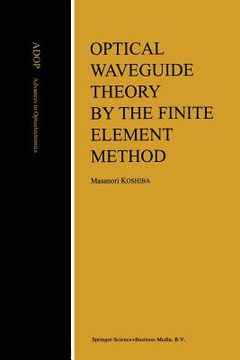
portada Optical Waveguide Theory by the Finite Element Method
Type
Physical Book
Publisher
Language
English
Pages
272
Format
Paperback
Dimensions
23.4x15.6x1.5 cm
Weight
0.41 kg.
ISBN13
9789401047135

Optical Waveguide Theory by the Finite Element Method

Masanori Koshiba (Author) · Springer · Paperback

Optical Waveguide Theory by the Finite Element Method - Koshiba, Masanori

Cheaper New Book Imported to Taiwan
Delivery: 02 Oct - 15 Oct Shipping: 13 to 17 business days.
NT$ 1,873
Faster New Book Imported to Taiwan
Delivery: 22 Sep - 30 Sep Shipping: 5 to 6 business days.
NT$ 2,403
NT$ 1,873

Synopsis "Optical Waveguide Theory by the Finite Element Method"

Recent advances in the field of guided-wave optics, such as fiber optics and integrated optics, have included the introduction of arbitrarily-shaped optical waveguides which, in many cases, also happened to be arbitrarily inhomogeneous, dissipative, anisotropic, and/or nonlinear. Most of such cases of waveguide arbitrariness do not lend themselves to analytical so- lutions; hence, computational tools for modeling and simulation are es- sential for successful design, optimization, and realization of the optical waveguides. For this purpose, various numerical techniques have been de- veloped. In particular, the finite element method (FEM) is a powerful and efficient tool for the most general (i. e., arbitrarily-shaped, inhomogeneous, dissipative, anisotropic, and nonlinear) optical waveguide problem. Its use in industry and research is extensive, and indeed it could be said that with- out it many optical waveguide problems would be incapable of solution. This book is intended for students, engineers, designers, and techni- cal managers interested in a detailed description of the FEM for optical waveguide analysis. Starting from a brief review of electromagnetic theory, the first chapter provides the concepts of the FEM and its fundamentals. In addition to conventional elements, i. e., line elements, triangular elements, tetrahedral elements, ring elements, and triangular ring elements which are utilized for one-dimensional, two-dimensional, three-dimensional, axisymmetric two- dimensional, and axisymmetric three-dimensional problems, respectively, special-purpose elements, such as isoparametric elements, edge elements, infinite elements, and boundary elements, are also introduced.

Customers reviews

Frequently Asked Questions about the Book

All books in our catalog are Original.
The book is written in English.
The binding of this edition is Paperback.

Questions and Answers about the Book

Do you have a question about the book? Login to be able to add your own question.

Opinions about Bookdelivery

More customer reviews