你好! Shipping to Taiwan with premium packaging for just NT$300 

Ship to
Taiwan
0
  • argentina
  • chile
  • colombia
  • españa
  • méxico
  • perú
  • estados unidos
  • internacional

Select your country

Americas

Europe

Rest of the world

portada Population-Level Ecological Risk Assessment
Population-Level Ecological Risk AssessmentPopulation-Level Ecological Risk AssessmentPopulation-Level Ecological Risk Assessment
Type
Physical Book
Publisher
Language
English
Pages
376
Format
Hardcover
Dimensions
23.9x16.5x2.4 cm
Weight
0.64 kg.
ISBN
1420053329
ISBN13
9781420053326

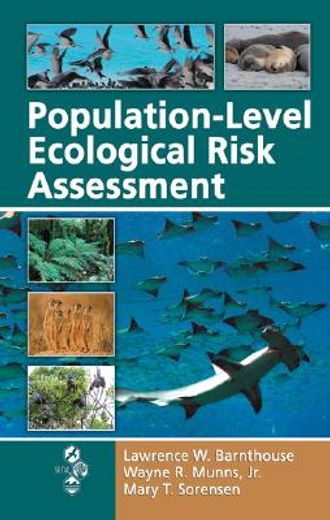
Population-Level Ecological Risk Assessment

Lawrence W. Barnthouse (Author) · Jr. Munns (Author) · Mary T. Sorensen (Author) · CRC Press · Hardcover

Population-Level Ecological Risk Assessment - Barnthouse, Lawrence W. ; Munns, Jr. ; Sorensen, Mary T.

New Book Imported to Taiwan
Delivery: 16 Nov - 24 Nov Shipping: 14 to 15 business days.
NT$ 9,571
NT$ 9,571

Synopsis "Population-Level Ecological Risk Assessment"

Most ecological risk assessments consider the risk to individual organisms or organism-level attributes. From a management perspective, however, risks to population-level attributes and processes are often more relevant. Despite many published calls for population risk assessment and the abundance of available scientific research and technical tools assessing risks to populations, risk assessors worldwide still have difficulty determining how population level considerations can be integrated into environmental decision-making. Population-Level Ecological Risk Assessment establishes a framework for goals, methods, and data needs for different assessment applications and for integrating population-level risk assessment into risk management decisions. Beginning with a summary of legal, regulatory, business, and other contexts, the book presents population-level ecological risk assessment as an internationally recognized, science-based tool and offers specific recommendations for using this tool to support environmental management decisions. It gives clear, explicit, operational population assessment definitions and explains the relevance of density dependence, genetics, and spatial considerations, as well as applicable lessons from conservation biology and natural resource management. The authors provide a "tool box" of empirical and modeling methods and describe the general approaches, assumptions, data requirements, strengths, and limitations of each method. They establish a working foundation for designing and conducting population-level ecological risk assessments consistent with North American, European, and Japanese risk management approaches. The book concludes by highlighting key considerations needed to improve the scientific quality and interpretation of assessments. Detailed appendices include examples of population-level assessment approaches applicable to specific environmental management contexts, a modeling case study, and a supplemental reading list.

Customers reviews

Frequently Asked Questions about the Book

All books in our catalog are Original.
The book is written in English.
The binding of this edition is Hardcover.

Questions and Answers about the Book

Do you have a question about the book? Login to be able to add your own question.

Opinions about Bookdelivery

More customer reviews