你好! Shipping to Taiwan with premium packaging for just NT$300 

Ship to
Taiwan
0
  • argentina
  • chile
  • colombia
  • españa
  • méxico
  • perú
  • estados unidos
  • internacional

Select your country

Americas

Europe

Rest of the world

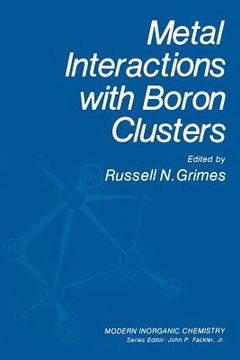
portada Metal Interactions with Boron Clusters
Type
Physical Book
Publisher
Language
English
Pages
327
Format
Paperback
Dimensions
23.4x15.6x1.8 cm
Weight
0.48 kg.
ISBN13
9781489921567

Metal Interactions with Boron Clusters

Russell N. Grimes (Author) · Springer · Paperback

Metal Interactions with Boron Clusters - Grimes, Russell N.

Cheaper New Book Imported to Taiwan
Delivery: 05 Oct - 16 Oct Shipping: 13 to 17 business days.
NT$ 5,013
Faster New Book Imported to Taiwan
Delivery: 23 Sep - 01 Oct Shipping: 5 to 6 business days.
NT$ 6,614
NT$ 5,013

Synopsis "Metal Interactions with Boron Clusters"

Molecular clusters, in the broad sense that the term is commonly understood, today comprise an enormous class of species extending into virtually every important area of chemistry: "naked" metal clusters, transition metal carbonyl clusters, hydrocarbon cages such as cubane (C H ) and dodecahedrane (C H ), 8 8 20 20 organometallic cluster complexes, enzymes containing Fe S or MoFe S 4 4 3 4 cores, high polymers based on carborane units, and, of course, the many kinds of polyhedral borane species. So large is the area spanned by these diverse classes that any attempt to deal with them comprehensively in one volume would, to say the least, be ambitious-and also premature. We are presently at a stage where intriguing relationships between the various cluster families are becoming apparent (particularly in terms of bonding descriptions), and despite large dif- ferences in their chemistry an underlying unity is gradually developing in the field. For example, structural changes occurring in Fe S cores as electrons are 4 4 pumped in and out, in some measure resemble those observed in boranes and carboranes. The cleavage of alkynes via incorporation into carborane cages and subsequent cage rearrangement, a sequence familiar to boron chemists, is a thermodynamically favored process which may be related to the behavior of unsaturated hydrocarbons on metal surfaces; analogies of this sort have drawn attention from theorists and experimentalists.

Customers reviews

Frequently Asked Questions about the Book

All books in our catalog are Original.
The book is written in English.
The binding of this edition is Paperback.

Questions and Answers about the Book

Do you have a question about the book? Login to be able to add your own question.

Opinions about Bookdelivery

More customer reviews