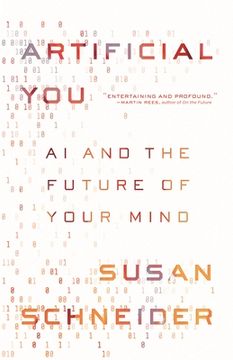
Synopsis "Artificial You: Ai and the Future of Your Mind"
A guide to AI's thorniest implications that asks: How shall we navigate our brave new world? We are at a monumental turning point in human history. AI is taking intelligence in new directions. The strongest human competitors in chess, go, and Jeopardy! have been beaten by AIs, and AI is getting more sophisticated by the day. Further, AI research is going inside the human brain itself, attempting to augment human minds. It may even create greater-than-human-level intelligence, leading to a new generation of artificial minds--Minds 2.0. Susan Schneider, a philosopher, argues that these undertakings must not be attempted without a richer understanding of the nature of the mind. An insufficient grasp of the underlying philosophical issues could undermine the use of AI and brain enhancement technology, bringing about the demise or suffering of conscious beings. Examining the philosophical questions lying beneath the algorithms, Schneider takes on AI's thorniest implications.
Susan M. Schneider es una filósofa estadounidense reconocida por sus aportes en la filosofía de la mente, la inteligencia artificial y la ciencia cognitiva. Nació en Estados Unidos y obtuvo su licenciatura en Economía por la Universidad de California, Berkeley, en 1993. Posteriormente, se doctoró en Filosofía en la Universidad de Rutgers bajo la tutela del destacado filósofo Jerry Fodor en 2003. Actualmente, ocupa la cátedra William F. Dietrich en la Universidad Atlántica de Florida (FAU), donde dirige el Center for the Future Mind, un centro dedicado a investigar el futuro de la inteligencia y la conciencia.
Su trabajo se centra en comprender la naturaleza de la mente, el yo y la conciencia, abordando cuestiones tanto desde la filosofía como desde la ciencia. Schneider ha explorado las implicaciones éticas y metafísicas de la inteligencia artificial avanzada y la posibilidad de que existan mentes artificiales o formas de inteligencia postbiológica. Entre sus obras más destacadas se encuentran The Language of Thought: A New Philosophical Direction (2011) y Artificial You: AI and the Future of Your Mind (2019).
Además de su labor académica, participa activamente en debates públicos sobre ética tecnológica y el futuro de la humanidad en la era de la inteligencia artificial.