Tracked shipping to Taiwan with premium packaging for just NT$300 

Ship to
Taiwan
0
  • argentina
  • chile
  • colombia
  • españa
  • méxico
  • perú
  • estados unidos
  • internacional

Select your country

Americas

Europe

Rest of the world

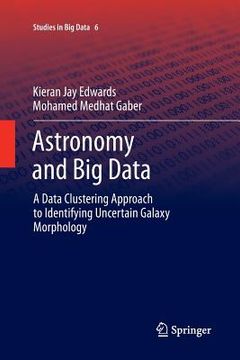
portada Astronomy and Big Data: A Data Clustering Approach to Identifying Uncertain Galaxy Morphology
Type
Physical Book
Publisher
Language
English
Pages
105
Format
Paperback
Dimensions
23.4 x 15.6 x 0.6 cm
Weight
0.18 kg.
ISBN13
9783319383286

Astronomy and Big Data: A Data Clustering Approach to Identifying Uncertain Galaxy Morphology

Mohamed Medhat Gaber (Author) · Kieran Jay Edwards (Author) · Springer · Paperback

Astronomy and Big Data: A Data Clustering Approach to Identifying Uncertain Galaxy Morphology - Edwards, Kieran Jay ; Gaber, Mohamed Medhat

Cheaper New Book Imported to Taiwan
Delivery: 25 Aug - 08 Sep Shipping: 12 to 16 business days.
NT$ 3,404
Faster New Book Imported to Taiwan
Delivery: 13 Aug - 21 Aug Shipping: 4 to 5 business days.
NT$ 4,649
NT$ 3,404

Synopsis "Astronomy and Big Data: A Data Clustering Approach to Identifying Uncertain Galaxy Morphology"

With the onset of massive cosmological data collection through media such as the Sloan Digital Sky Survey (SDSS), galaxy classification has been accomplished for the most part with the help of citizen science communities like Galaxy Zoo. Seeking the wisdom of the crowd for such Big Data processing has proved extremely beneficial. However, an analysis of one of the Galaxy Zoo morphological classification data sets has shown that a significant majority of all classified galaxies are labelled as "Uncertain".This book reports on how to use data mining, more specifically clustering, to identify galaxies that the public has shown some degree of uncertainty for as to whether they belong to one morphology type or another. The book shows the importance of transitions between different data mining techniques in an insightful workflow. It demonstrates that Clustering enables to identify discriminating features in the analysed data sets, adopting a novel feature selection algorithms called Incremental Feature Selection (IFS). The book shows the use of state-of-the-art classification techniques, Random Forests and Support Vector Machines to validate the acquired results. It is concluded that a vast majority of these galaxies are, in fact, of spiral morphology with a small subset potentially consisting of stars, elliptical galaxies or galaxies of other morphological variants.

Customers reviews

Frequently Asked Questions about the Book

All books in our catalog are Original.
The book is written in English.
The binding of this edition is Paperback.

Questions and Answers about the Book

Do you have a question about the book? Login to be able to add your own question.

Opinions about Bookdelivery

More customer reviews