你好! Shipping to Taiwan with premium packaging for just NT$300 

Ship to
Taiwan
0
  • argentina
  • chile
  • colombia
  • españa
  • méxico
  • perú
  • estados unidos
  • internacional

Select your country

Americas

Europe

Rest of the world

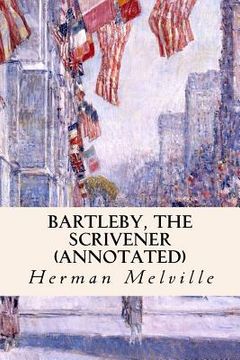
portada Bartleby, The Scrivener (annotated)
Type
Physical Book
Publisher
Language
English
Pages
74
Format
Paperback
Dimensions
22.9x15.2x0.4 cm
Weight
0.11 kg.
ISBN13
9781518803949

Bartleby, The Scrivener (annotated)

Herman Melville (Author) · Createspace · Paperback

Bartleby, The Scrivener (annotated) - Melville, Herman

New Book Imported to Taiwan
Delivery: 29 Sep - 12 Oct Shipping: 16 to 20 business days.
NT$ 581
NT$ 581

Synopsis "Bartleby, The Scrivener (annotated)"

"Bartleby, the Scrivener: A Story of Wall Street" is a short story by the American writer Herman Melville, first serialized anonymously in two parts in the November and December 1853 issues of Putnam's Magazine, and reprinted with minor textual alterations in his The Piazza Tales in 1856. A Wall Street lawyer hires a new clerk who, after an initial bout of hard work, refuses to make copy and any other task required of him, with the words "I would prefer not to". Numerous essays have been published on what, according to scholar Robert Milder, "is unquestionably the masterpiece of the short fiction" in the Melville canon. Melville's major source for the story was an advertisement for a new book, The Lawyer's Story, printed in both the Tribune and the Times for 18 February 1853. The book was published anonymously later that year but in fact was written by popular novelist James A. Maitland.[2] This advertisement included the complete first chapter, which had the following opening sentence: "In the summer of 1843, having an extraordinary quantity of deeds to copy, I engaged, temporarily, an extra copying clerk, who interested me considerably, in consequence of his modest, quiet, gentlemanly demeanor, and his intense application to his duties". Melville biographer Hershel Parker points out that nothing else in the chapter besides this "remarkably evocative sentence" was "notable".[3] Critic Andrew Knighton notes the debt of the story to an obscure work from 1846, Robert Grant White's Law and Laziness: or, Students at Law of Leisure. This source contains one scene and many characters - including an idle scrivener - that appear to have influenced Melville's narrative.[4] Melville may have written the story as an emotional response to the bad reviews garnered by Pierre, his preceding novel.[5] Christopher Sten suggests that Melville found inspiration in Ralph Waldo Emerson's essays, particularly "The Transcendentalist" which shows parallels to "Bartleby". Bartleby is a scrivener-a kind of clerk or a copyist-"who obstinately refuses to go on doing the sort of writing demanded of him". During the spring of 1851, Melville felt similarly about his work on Moby Dick. Thus, Bartleby may represent Melville's frustration with his own situation as a writer, and the story itself is "about a writer who forsakes conventional modes because of an irresistible preoccupation with the most baffling philosophical questions".[7] Bartleby may also be seen to represent Melville's relation to his commercial, democratic society.[8] Melville made an allusion to the John C. Colt case in this short story. The narrator restrains his anger toward Bartleby, his unrelentingly difficult employee, by reflecting upon "the tragedy of the unfortunate Adams and the still more unfortunate Colt and how poor Colt, being dreadfully incensed by Adams [...] was unawares hurled into his fatal act".
Herman Melville
  (Author)
View Author's Page
Herman Melville (New York, August 1, 1819-New York, September 28, 1891)1 was an American writer, novelist, poet, and essayist from the American Renaissance period. Among his most famous novels are Typee (1846), based on his experiences in Polynesia, and the novel Moby Dick (1851),1 considered his masterpiece and a classic of world literature

Between 1853 and 1855, he published a series of stories in Putnam Magazine, most of which were collected in The Piazza Tales, including two of Melville's most important narratives: the story Bartleby, the Scrivener and the novella Benito Cereno. Also featured is the story The Encantadas, consisting of ten sketches about the Galapagos Islands linked by a single narrator. In 1857, The Confidence-Man: His Masquerade, also known as The Confidence-Man, was the last prose fiction work he published. Seeking financial stability, he abandoned writing, accepting a position as a customs inspector

In his later years, in which he also had to endure the death of two of his brothers as well as the death of two of his sons, Clarence, from tuberculosis, and Malcolm from a possible suicide, as well as the death of another of his sons at thirty-five years old, Stanwix Melville, he dedicated himself to writing poetry. Battle-Pieces and Aspects of the War, from 1866, is a poetic reflection on the Civil War and Clarel: A Poem and Pilgrimage in the Holy Land, a fictional epic poem, published in 1876. The novel Billy Budd, which he left unfinished and was posthumously published in London in 1924, is considered one of the most significant works of American literature.
See more
See less

Customers reviews

Frequently Asked Questions about the Book

All books in our catalog are Original.
The book is written in English.
The binding of this edition is Paperback.

Questions and Answers about the Book

Do you have a question about the book? Login to be able to add your own question.

Opinions about Bookdelivery

More customer reviews