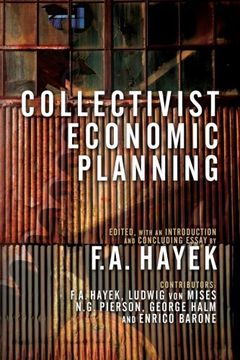
In 1920, Ludwig von Mises dropped a bombshell on the European economic world with his article called "Economic Calculation in the Socialist Commonwealth." It argued that socialism was impossible as an economic system. It set off two decades of debate, so by the time the essays appeared in English, in this very book here, in 1935, the debate was still raging. This volume edited by F.A. Hayek dug the knife into socialism's heart unlike any book to ever appear. It contains essays by Mises along with a foreword and afterword by Hayek. It also contains more commentary by N.G. Pierson, George Halm, and Enrico Barone. It is exceptionally well edited and beautifully argued, and has not been in print for many years. The contents are nothing short of prophetic. The so-called "Calculation Argument" has never been answered. It shows that without private property in capital goods, there can be no prices and hence no data available for cost accounting. Production becomes random at best, and completely irrational. Mises had convinced his generation and this book completely devastates the whole socialist apparatus from a theoretical point of view. No one interested in this debate can afford not to be well-versed in the contents of this book.
Ludwig von Mises fue un economista y filósofo austro-estadounidense considerado una de las figuras centrales de la Escuela Austríaca de economía. Nacido en 1881 en lo que entonces era el Imperio austrohúngaro, desarrolló teorías influyentes sobre liberalismo clásico, mercado libre, dinero y acción humana. Su pensamiento se opuso firmemente al socialismo y a la planificación económica centralizada, argumentando que una economía sin precios de mercado reales no podía asignar recursos de manera eficiente. Tras emigrar a Estados Unidos durante la Segunda Guerra Mundial, continuó enseñando e influyendo sobre generaciones de economistas y pensadores libertarios. Leerlo exige paciencia: Mises escribía como alguien convencido de que una idea compleja merece todas las páginas necesarias… y quizá algunas más.
Su obra más reconocida es La acción humana (Human Action), publicada en 1949, texto fundamental donde desarrolla la praxeología, teoría que estudia la acción racional de los individuos. También escribió libros influyentes como Socialismo, La teoría del dinero y del crédito y Liberalismo. Su pensamiento impactó profundamente en autores posteriores como Friedrich Hayek y Murray Rothbard, además de convertirse en referencia constante dentro de debates sobre economía, intervención estatal y libertad individual.