你好! Shipping to Taiwan with premium packaging for just NT$300 

Ship to
Taiwan
0
  • argentina
  • chile
  • colombia
  • españa
  • méxico
  • perú
  • estados unidos
  • internacional

Select your country

Americas

Europe

Rest of the world

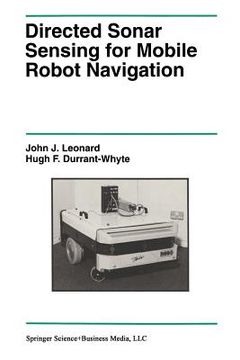
portada Directed Sonar Sensing for Mobile Robot Navigation
Type
Physical Book
Publisher
Language
English
Pages
183
Format
Paperback
Dimensions
23.4x15.6x1.1 cm
Weight
0.30 kg.
ISBN13
9781461366256

Directed Sonar Sensing for Mobile Robot Navigation

Hugh F. Durrant-Whyte (Author) · John J. Leonard (Author) · Springer · Paperback

Directed Sonar Sensing for Mobile Robot Navigation - Leonard, John J. ; Durrant-Whyte, Hugh F.

Cheaper New Book Imported to Taiwan
Delivery: 30 Sep - 13 Oct Shipping: 12 to 16 business days.
NT$ 5,013
Faster New Book Imported to Taiwan
Delivery: 18 Sep - 28 Sep Shipping: 4 to 5 business days.
NT$ 6,614
NT$ 5,013

Synopsis "Directed Sonar Sensing for Mobile Robot Navigation"

This monograph is a revised version of the D.Phil. thesis of the first author, submitted in October 1990 to the University of Oxford. This work investigates the problem of mobile robot navigation using sonar. We view model-based navigation as a process of tracking naturally occurring environment features, which we refer to as "targets". Targets that have been predicted from the environment map are tracked to provide that are observed, but not predicted, vehicle position estimates. Targets represent unknown environment features or obstacles, and cause new tracks to be initiated, classified, and ultimately integrated into the map. Chapter 1 presents a brief definition of the problem and a discussion of the basic research issues involved. No attempt is made to survey ex- haustively the mobile robot navigation literature-the reader is strongly encouraged to consult other sources. The recent collection edited by Cox and Wilfong [34] is an excellent starting point, as it contains many of the standard works of the field. Also, we assume familiarity with the Kalman filter. There are many well-known texts on the subject; our notation derives from Bar-Shalom and Fortmann [7]. Chapter 2 provides a detailed sonar sensor model. A good sensor model of our approach to navigation, and is used both for is a crucial component predicting expected observations and classifying unexpected observations.

Customers reviews

Frequently Asked Questions about the Book

All books in our catalog are Original.
The book is written in English.
The binding of this edition is Paperback.

Questions and Answers about the Book

Do you have a question about the book? Login to be able to add your own question.

Opinions about Bookdelivery

More customer reviews