Entrepreneurship and Innovation Policy and the Economy: Volume 2 (Volume 2) (Nber-Entrepreneurship and Innovation Policy and the Economy) - Jones, Benjamin F.
New Book
Imported
to Taiwan
Delivery: 14 Jul - 21 Jul
Shipping: 2 to 2 business days.
NT$ 2,474
NT$ 2,474
Choose the list to add your product or create one New List
Entrepreneurship and Innovation Policy and the Economy: Volume 2 (Volume 2) (Nber-Entrepreneurship and Innovation Policy and the Economy)
Jones, Benjamin F.
Synopsis "Entrepreneurship and Innovation Policy and the Economy: Volume 2 (Volume 2) (Nber-Entrepreneurship and Innovation Policy and the Economy) "
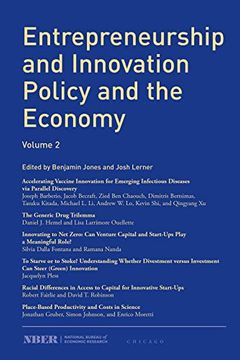
Rigorous nonpartisan research on the effects of economic forces and public policy on entrepreneurship and innovation. Entrepreneurship and innovation are widely recognized as drivers of economic dynamics and long-term prosperity. This series communicates key findings about the implications of entrepreneurial and innovative activity across the economy. In the first paper, Joseph Barberio, Jacob Becraft, Zied Ben Chaouch, Dimitris Bertsimas, Tasuku Kitada, Michael Li, Andrew Lo, Kevin Shi, and Qingyang Xu explore pharmaceutical firms' weak incentives to develop vaccines against prospective diseases--due to high investment risks, low expected returns, and the rarity of pandemics-- and consider a portfolio approach to financing vaccine research. Next, Daniel Hemel and Lisa Larrimore Ouellette describe a "trilemma" between quality, price, and access that appears after a generic pharmaceuticals patent expires, and show that it is difficult in a regulatory context to achieve distinct goals around price, access, and quality simultaneously. In the third paper, Silvia Dalla Fontana and Ramana Nanda examine the role of patents in the transition to a carbon-free world. They find relative to other technological areas, "Net Zero patents" are close to the scientific frontier, but due to difficulties of commercializing inventions, the share of such patents that are venture-backed has been increasingly directed to areas outside clean tech and other "deep" technologies. Jacquelyn Pless examines the effects of divestment from firms in "dirty" industries on innovation to combat climate change, or "green innovation." She finds that compared with divesting, investing in firms and engaging with green corporate governance practices may induce more green innovation. Next, Robert Fairlie and David Robinson find that Black-owned innovative-intensive new businesses start smaller than their peers and do not converge in size over time. Differential access to bank financing is a major factor. Also "soft information," which can help new businesses without established track records, can increase barriers for black founders and limit entrepreneurial pathways to prosperity. Finally, Jonathan Gruber, Simon Johnson, and Enrico Moretti consider the regional concentration of innovative activity in the United States. They find that while the concentration of activity has net advantages today, understanding the long-term benefits of more diffuse innovation clusters --including equity, industrial diversification, and talent development--is important.