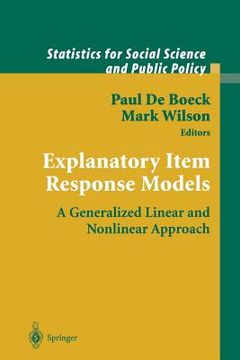
This edited volume gives a new and integrated introduction to item response models (predominantly used in measurement applications in psychology, education, and other social science areas) from the viewpoint of the statistical theory of generalized linear and nonlinear mixed models. Moreover, this new framework allows the domain of item response models to be co-ordinated and broadened to emphasize their explanatory uses beyond their standard descriptive uses. The basic explanatory principle is that item responses can be modelled as a function of predictors of various kinds. The predictors can be (a) characteristics of items, of persons, and of combinations of persons and items; they can be (b) observed or latent (of either items or persons); and they can be (c) latent continuous or latent categorical. Thus, a broad range of models is generated, including a wide range of extant item response models as well as some new ones. Within this range, models with explanatory predictors are given special attention in this book, but we also discuss descriptive models. Note that the "item responses" that we are referring to are not just the traditional "test data," but are broadly conceived as categorical data from a repeated observations design. Hence, data from studies with repeated observations experimental designs, or with longitudinal designs, may also be modelled.The book starts with a four-chapter section containing an introduction to the framework. The remaining chapters describe models for ordered-category data, multilevel models, models for differential item functioning, multidimensional models, models for local item dependency, and mixture models. It also includes a chapter on the statistical background and one on useful software. In order to make the task easier for the reader, a unified approach to notation and model description is followed throughout the chapters, and a single data set is used in most examples to make it easier to see how the many models are related. For all major examples, computer commands from the SAS package are provided which can be used to estimate the results for each model. In addition, sample commands are provided for other major computer packages.Paul De Boeck is Professor of Psychology at K.U. Leuven (Belgium), and Mark Wilson is Professor of Education at UC Berkeley (USA). They are also co-editors (along with Pamela Moss) of a new journal entitled Measurement: Interdisciplinary Research and Perspectives. The chapter authors are members of a collaborative group of psychometricians and statisticians centered on K.U. Leuven and UC Berkeley.