你好! Shipping to Taiwan with premium packaging for just NT$300 

Ship to
Taiwan
0
  • argentina
  • chile
  • colombia
  • españa
  • méxico
  • perú
  • estados unidos
  • internacional

Select your country

Americas

Europe

Rest of the world

portada Farsite: Fire Area Simulator?Model Development and Evaluation
Type
Physical Book
Publisher
Language
English
Pages
50
Format
Paperback
Dimensions
28x21.6x0.3 cm
Weight
0.14 kg.
ISBN13
9781511539548

Farsite: Fire Area Simulator?Model Development and Evaluation

United States Department Of Agriculture (Author) · Createspace · Paperback

Farsite: Fire Area Simulator?Model Development and Evaluation - United States Department of Agriculture

New Book Imported to Taiwan
Delivery: 16 Oct - 29 Oct Shipping: 16 to 20 business days.
NT$ 908
NT$ 908

Synopsis "Farsite: Fire Area Simulator?Model Development and Evaluation"

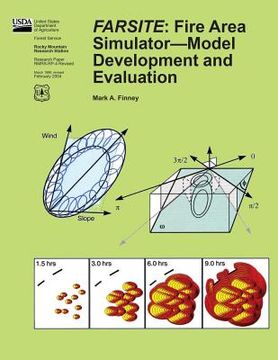
This paper reports on the structure of a fire growth simulation model, FARSITE, and its performance under simplified test conditions. FARSITE incorporates existing models of surface fire, crown fire, point-source fire acceleration, spotting, and fuel moisture. This documentation of how the simulation was constructed, and how the individual fire behavior models perform, will be useful to researchers and managers who use FARSITE or are interested in fire growth simulation. The models were integrated using a vector propagation technique for fire perimeter expansion that controls for both space and time resolution of fire growth over the landscape. The model produces vector fire perimeters (polygons) at specified time intervals. The vertices of these polygons contain information on the fire's spread rate and intensity, which are interpolated to produce raster maps of fire behavior. Because fire behavior at each vertex is assumed independent of the others, the simulation outputs illustrate the strict spatial consequences to fire behavior of incorporating the models into a two-dimensional simulation. Simplified test conditions show that surface fire growth and intensity conform to idealized patterns. Similarities also exist between simulated crown fires and observed patterns of extreme wind-driven fires. Complex patterns of fire growth and behavior result from the spatial and temporal dependencies in the model. The limitations and assumptions of this approach are discussed.

Customers reviews

Frequently Asked Questions about the Book

All books in our catalog are Original.
The book is written in English.
The binding of this edition is Paperback.

Questions and Answers about the Book

Do you have a question about the book? Login to be able to add your own question.

Opinions about Bookdelivery

More customer reviews