你好! Shipping to Taiwan with premium packaging for just NT$300 

Ship to
Taiwan
0
  • argentina
  • chile
  • colombia
  • españa
  • méxico
  • perú
  • estados unidos
  • internacional

Select your country

Americas

Europe

Rest of the world

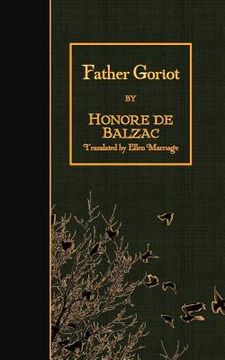
portada Father Goriot
Type
Physical Book
Translated by
Publisher
Language
English
Pages
224
Format
Paperback
Dimensions
20.3x12.7x1.3 cm
Weight
0.24 kg.
ISBN13
9781508601890

Father Goriot

Honoré De Balzac (Author) · Ellen Marriage (Translated by) · Createspace · Paperback

Father Goriot - Honoré De Balzac

New Book Imported to Taiwan
Delivery: 29 Sep - 12 Oct Shipping: 16 to 20 business days.
NT$ 719
NT$ 719

Synopsis "Father Goriot"

Mme. Vauquer (nee de Conflans) is an elderly person, who for the past forty years has kept a lodging-house in the Rue Nueve-Sainte-Genevieve, in the district that lies between the Latin Quarter and the Faubourg Saint-Marcel. Her house (known in the neighborhood as the Maison Vauquer) receives men and women, old and young, and no word has ever been breathed against her respectable establishment; but, at the same time, it must be said that as a matter of fact no young woman has been under her roof for thirty years, and that if a young man stays there for any length of time it is a sure sign that his allowance must be of the slenderest. In 1819, however, the time when this drama opens, there was an almost penniless young girl among Mme. Vauquer's boarders. That word drama has been somewhat discredited of late; it has been overworked and twisted to strange uses in these days of dolorous literature; but it must do service again here, not because this story is dramatic in the restricted sense of the word, but because some tears may perhaps be shed intra et extra muros before it is over. Will any one without the walls of Paris understand it? It is open to doubt. The only audience who could appreciate the results of close observation, the careful reproduction of minute detail and local color, are dwellers between the heights of Montrouge and Montmartre, in a vale of crumbling stucco watered by streams of black mud, a vale of sorrows which are real and joys too often hollow; but this audience is so accustomed to terrible sensations, that only some unimaginable and well-neigh impossible woe could produce any lasting impression there. Now and again there are tragedies so awful and so grand by reason of the complication of virtues and vices that bring them about, that egotism and selfishness are forced to pause and are moved to pity; but the impression that they receive is like a luscious fruit, soon consumed. Civilization, like the car of Juggernaut, is scarcely stayed perceptibly in its progress by a heart less easy to break than the others that lie in its course; this also is broken, and Civilization continues on her course triumphant. And you, too, will do the like; you who with this book in your white hand will sink back among the cushions of your armchair, and say to yourself, "Perhaps this may amuse me." You will read the story of Father Goriot's secret woes, and, dining thereafter with an unspoiled appetite, will lay the blame of your insensibility upon the writer, and accuse him of exaggeration, of writing romances. Ah! once for all, this drama is neither a fiction nor a romance! All is true, -so true, that every one can discern the elements of the tragedy in his own house, perhaps in his own heart. During the day a glimpse into the garden is easily obtained through a wicket to which a bell is attached. On the opposite wall, at the further end of the graveled walk, a green marble arch was painted once upon a time by a local artist, and in this semblance of a shrine a statue representing Cupid is installed; a Parisian Cupid, so blistered and disfigured that he looks like a candidate for one of the adjacent hospitals, and might suggest an allegory to lovers of symbolism. The half-obliterated inscription on the pedestal beneath determines the date of this work of art, for it bears witness to the widespread enthusiasm felt for Voltaire on his return to Paris in 1777: "Whoe'er thou art, thy master see; He is, or was, or ought to be."
Honoré De Balzac
  (Author)
View Author's Page
Honoré de Balzac (1799-1851), novelist, playwright, literary and art critic, essayist, journalist, and French printer, is considered one of the great writers of realism. Born in Tours, in 1814 he moved to Paris, where he studied law and began working in a law firm, but his love for literature drove him to abandon his career and dedicate himself to writing. He undertook several businesses, which ended in failure and left him in debt. With The Last Chouan (1829), he achieved great success. From then on, he began a feverish activity, writing, among others, The Physiology of Marriage (1829) and The Wild Ass's Skin (1831), with which he began to consolidate his prestige. In 1834, Balzac, a tireless worker, conceived the idea of making an exhaustive portrait of French society of his time by having the same characters appear in different stories, which began to give his work a unitary sense under the title of The Human Comedy, to which belong titles such as Eugénie Grandet (1833), Father Goriot (1835), Splendors and Miseries of Courtesans (1838-1847) or Cousin Bette (1846), although of the 137 novels that were to make it up, fifty remained incomplete. An extraordinary writer, capable of deploying in his works sublime reflections and ideas, creating an interesting story with strong social criticism through exquisite prose of great poetic level and philosophical depth, Balzac is considered the founder of the modern novel.
See more
See less

Customers reviews

Frequently Asked Questions about the Book

All books in our catalog are Original.
The book is written in English.
The binding of this edition is Paperback.

Questions and Answers about the Book

Do you have a question about the book? Login to be able to add your own question.

Opinions about Bookdelivery

More customer reviews