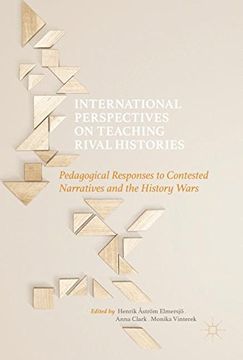
International Perspectives on Teaching Rival Histories: Pedagogical Responses to Contested Narratives and the History Wars - Henrik Åström Elmersjö,Anna Clark,Monika Vinterek
Cheaper New Book
Imported
to Taiwan
*
Delivery: 02 Jun - 18 Jun
Shipping: 11 to 18 business days.
NT$ 3,888
Faster New Book
Imported
to Taiwan
*
Delivery: 22 May - 02 Jun
Shipping: 5 to 6 business days.
NT$ 5,519
NT$ 3,888
Delivery to any Taiwan address between Tuesday, June 02 and Thursday, June 18
Shipping
Origin: U.S.A.
Import costs included in the price ✅
Delivery to any Taiwan address between Tuesday, June 02 and Thursday, June 18.
NT$ 5,519
Delivery to any Taiwan address between Friday, May 22 and Tuesday, June 02
Shipping
Origin: United Kingdom
Import costs included in the price ✅
Delivery to any Taiwan address between Friday, May 22 and Tuesday, June 02.
Choose the list to add your product or create one New List
International Perspectives on Teaching Rival Histories: Pedagogical Responses to Contested Narratives and the History Wars
Henrik Åström Elmersjö,Anna Clark,Monika Vinterek
Synopsis "International Perspectives on Teaching Rival Histories: Pedagogical Responses to Contested Narratives and the History Wars "
This book presents a survey of approaches to dealing with `rival histories' in the classroom, arguing that approaching this problem requires great sensitivity to differing national, educational and narrative contexts. Contested narratives and disputed histories have long been an important issue in history-teaching all over the world, and have even been described as the `history' or `culture' wars. In this book, authors from across the globe ponder the question "what can teachers do (and what are they doing) to address conflicting narratives of the same past?", and puts an epistemological issue at the heart of the discussion: what does it mean for the epistemology of history, if it is possible to teach more than one narrative? Divided into three sections that deal with historical cultures, multicultural societies and multiperspectivity, the chapters of the book showcase that dealing with rival histories is very much dependent on context, and that diverse teaching traditions and societal debates mean that teachers' abilities in engaging with the teaching of rival narratives are very different. The volume will be compelling reading for students and researchers in the fields of education, history, sociology and philosophy, as well as practising teachers.