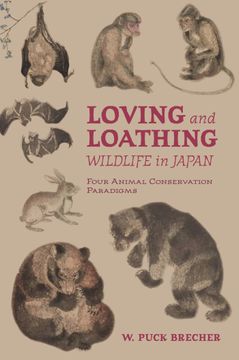
Loving and Loathing Wildlife in Japan. Four Animal Conservation Paradigms
W. Puck Brecher
Synopsis "Loving and Loathing Wildlife in Japan. Four Animal Conservation Paradigms"
For over a century, Japan has vexed and disappointed its Western allies by resisting their efforts to protect biodiversity. Consequently, foreign critics have long derided Japan as "the world’s boldest eco-outlaw." Its animal protections are equally disappointing: comprehensive assessments by the World Animal Protection Index rank Japan among the worst in the developed world. Given Japan’s close relationships with its foreign allies, its systemic disregard for wildlife conservation seems strangely out of character. Wildlife conservation, in fact, arguably stands as one of the greatest and most enduring sources of friction between Japan and the Western order. This enigma is neither easily understood nor rectified. Loving and Loathing Wildlife in Japan explores Japan’s complex relationship with wildlife conservation, an issue that currently challenges societies around the world. Tracing the topic from the seventeenth-century animal laws to the 1999 Act on the Welfare and Management of Animals, W. Puck Brecher examines the four dominant paradigms—compassionate control (pre-1868), utility (1868–1945), conservation (1868–1980), and welfare (1902–1999)—that have dictated how Japan has conceptualized and handled its engagements with wildlife. These paradigms span the broad range of political and attitudinal approaches adopted by modernizing Japan as it sought to manage its wildlife resources. Each offers a distinctive perspective on Japanese society, politics, and their relationship with the natural environment. Collectively, their historical arc invites readers to contemplate patterns that have variously advanced and hindered wildlife conservation, as well as potentials for future improvement. In doing so, the book illuminates historical contexts necessary to understand modern Japan’s puzzling reputation as an environmental outlier and its struggle to reconcile tradition with environmental responsibility.