Tracked shipping to Taiwan with premium packaging for just NT$300 

Ship to
Taiwan
0
  • argentina
  • chile
  • colombia
  • españa
  • méxico
  • perú
  • estados unidos
  • internacional

Select your country

Americas

Europe

Rest of the world

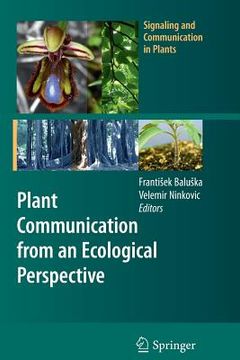
portada plant communication from an ecological perspective
Type
Physical Book
Publisher
Year
2012
Language
English
Pages
252
Format
Paperback
Dimensions
22.9 x 15.5 x 1.8 cm
Weight
0.43 kg.
ISBN
3642263666
ISBN13
9783642263668

plant communication from an ecological perspective

Frantisek Baluska (Illustrated by) · Velemir Ninkovic (Illustrated by) · Springer · Paperback

plant communication from an ecological perspective - Baluska, Frantisek ; Ninkovic, Velemir

Cheaper New Book Imported to Taiwan
Delivery: 24 Aug - 07 Sep Shipping: 12 to 16 business days.
NT$ 5,057
Faster New Book Imported to Taiwan
Delivery: 12 Aug - 20 Aug Shipping: 4 to 5 business days.
NT$ 6,638
NT$ 5,057

Synopsis "plant communication from an ecological perspective"

Since the concept of allelopathy was introduced almost 100 years ago, research has led to an understanding that plants are involved in complex communicative interactions. They use a battery of different signals that convey plant-relevant information within plant individuals as well as between plants of the same species or different species. The 13 chapters of this volume discuss all these topics from an ecological perspective. Communication between plants allows them to share physiological and ecological information relevant for their survival and ?tness. It is obvious that in these very early days of ecological plant communication research we are illuminating only the 'tip of iceberg' of the communicative nature of higher plants. Nevertheless, knowledge on the identity and informative value of volatiles used by plants for communication is increasing with breath-taking speed. Among the most spectacular examples are sit- tions where plant emitters warn neighbours about a danger, increasing their innate immunity, or when herbivore-attacked plants attract the enemies of the herbivores ('cry for help' and 'plant bodyguards' concepts). It is becoming obvious that plants use not only volatile signals but also diverse water soluble molecules, in the case of plant roots, to safeguard their evolutionary success and accomplish self/non-self kin rec- nition. Importantly, as with all the examples of biocommunication, irrespective of whether signals and signs are transmitted via physical or chemical pathways, plant communication is a rule-governed and sign-mediated process.

Customers reviews

Frequently Asked Questions about the Book

All books in our catalog are Original.
The book is written in English.
The binding of this edition is Paperback.

Questions and Answers about the Book

Do you have a question about the book? Login to be able to add your own question.

Opinions about Bookdelivery

More customer reviews