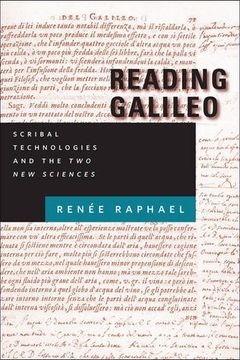
Reading Galileo: Scribal Technologies and the Two New Sciences
Raphael, Renée
Synopsis "Reading Galileo: Scribal Technologies and the Two New Sciences"
How did early modern scientists interpret Galileo's influential Two New Sciences?In 1638, Galileo was over seventy years old, blind, and confined to house arrest outside of Florence. With the help of friends and family, he managed to complete and smuggle to the Netherlands a manuscript that became his final published work, Two New Sciences. Treating diverse subjects that became the foundations of mechanical engineering and physics, this book is often depicted as the definitive expression of Galileo's purportedly modern scientific agenda. In Reading Galileo, Renée Raphael offers a new interpretation of Two New Sciences which argues instead that the work embodied no such coherent canonical vision. Raphael alleges that it was written--and originally read--as the eclectic product of the types of discursive textual analysis and meandering descriptive practices Galileo professed to reject in favor of more qualitative scholarship. Focusing on annotations period readers left in the margins of extant copies and on the notes and teaching materials of seventeenth-century university professors whose lessons were influenced by Galileo's text, Raphael explores the ways in which a range of early-modern readers, from ordinary natural philosophers to well-known savants, responded to Galileo. She highlights the contrast between the practices of Galileo's actual readers, who followed more traditional, "bookish" scholarly methods, and their image, constructed by Galileo and later historians, as "modern" mathematical experimenters. Two New Sciences has not previously been the subject of such rigorous attention and analysis. Reading Galileo considerably changes our understanding of Galileo's important work while offering a well-executed case study in the reception of an early-modern scientific classic. This important text will be of interest to a wide range of historians--of science, of scholarly practices and the book, and of early-modern intellectual and cultural history.