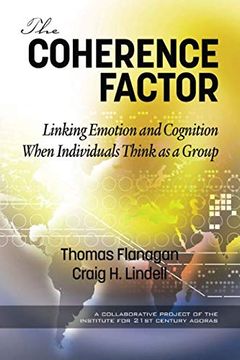
The Coherence Factor: Linking Emotion and Cognition When Individuals Think as a Group
Thomas R. Flanagan; Craig H. Lindell
Synopsis "The Coherence Factor: Linking Emotion and Cognition When Individuals Think as a Group "
Cogito, ergo sum. (""I think, therefore I am."") When Descartes quipped this, he erroneously split thinking from feeling. He assumed thoughts emerge from a substance other than feeling. This is a historic tragedy, and it is unnecessary. It brings us to a risky end-game. When we attempt to meld preconceived thought with evoked feelings, we come to the craft of ""spin doctors."" Instead, there is a natural path for connecting thinking and feeling. It involves emotional reflection at the time that understandings are created. This book draws attention to a form of dialogue which is called design dialogue. Design dialogue constructs new meaning from the bottom up. Individuals construct new meanings through individual thinking. In design dialogue, meaning results from group thinking. Group thinking is not as simple as thinking individually while being present within a group. The design process results in a series of co-constructed learning artifacts which, ultimately, constitute a new understanding. The process is concurrently emotional and cognitive, and melding emotion and cognition is achievable with effective design dialogue methods. The first chapter introduces emotion as the catalyst for considering questions, persisting in reflection, and concluding a cycle of thought. This chapter fills in gaps with the treatment of emotion and cognition. The second chapter lays out the sequence of observation-taking, sensemaking, meaning-making, and perspective-taking that are essential steps in thinking. Frameworks for thinking in educational traditions focus not so much on the neurological mechanics of the thought process but rather on the overall internalization of a ""way"" of understanding things. A third chapter presents a methodology for managing a design dialogue. Group facilitators generally invent and modify their own approaches for leading design projects. This chapter presents a codified approach that offers an advantage of supporting continuous improvement of complex design management methodology. And the final chapter considers the emergence of a sapient group-mind through the agency of design dialogue. This conjectured group-mind is considered in the context of the civic infrastructure that is needed to sustain the continual growth of the human superorganism structure. As humanity has moved from tribes, to cities, to institutions, and now to globally connected networks, each leap forward has been accompanied by profound changes in social practices and belief systems. Recent findings from the field of cognitive science have confirmed a suspicion that we have long held about each other. Individual thinking is biased and flawed. Inclusive and democratically managed discussion, deliberation and design all help to identify and dampen flawed understandings. The individual mind, an essential ingredient in the human spirit, is now, as a matter of practical necessity, bending to the wisdom of a well-informed group mind. The speed and strength of newly emerging social forces and evolving civic trends point to the conclusion that we are on the threshold for a new way of being. This book seeks to evoke reflection on how we can start communicating in a way that prepares us for life in that new future.