Tracked shipping to Taiwan with premium packaging for just NT$300 

Ship to
Taiwan
0
  • argentina
  • chile
  • colombia
  • españa
  • méxico
  • perú
  • estados unidos
  • internacional

Select your country

Americas

Europe

Rest of the world

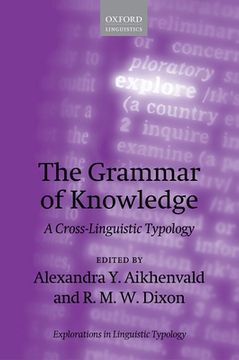
portada The Grammar of Knowledge: A Cross-Linguistic Typology (Explorations in Linguistic Typology)
Type
Physical Book
Language
English
Pages
320
Format
Paperback
Dimensions
23.4 x 15.5 x 1.8 cm
Weight
0.48 kg.
ISBN13
9780198736707
Edition No.
1

The Grammar of Knowledge: A Cross-Linguistic Typology (Explorations in Linguistic Typology)

R. M. W. Dixon (Illustrated by) · Alexandra Y. Aikhenvald (Illustrated by) · Oxford University Press · Paperback

The Grammar of Knowledge: A Cross-Linguistic Typology (Explorations in Linguistic Typology) - Aikhenvald, Alexandra Y. ; Dixon, R. M. W.

New Book Imported to Taiwan
Delivery: 20 Aug - 02 Sep Shipping: 10 to 13 business days.
NT$ 2,507
NT$ 2,507

Synopsis "The Grammar of Knowledge: A Cross-Linguistic Typology (Explorations in Linguistic Typology) "

The Grammar of Knowledge offers both a linguistic and anthropological perspective on the expression of information sources, as well as inferences, assumptions, probability and possibility, and gradations of doubt and beliefs in a range of languages. The book investigates twelve different languages, from families including Tibeto-Burman, Nakh-Dagestani, and Austronesian, all of which share the property of requiring the source of information to be specified in every sentence. In these languages, it may not be possible to say merely that 'the man went fishing'. Instead, the source of evidence for the statement must also be specified, usually through the use of evidential markers. For example, it may be necessary to indicate whether the speaker saw the man go fishing; has simply assumed that the man went fishing; or was told that he went fishing by a third party. Some languages, such as Hinuq and Tatar, distinguish between first-hand and non first-hand information sources; others, such as Ersu, mark three distinct types of information - directly required, inferred or assumed, and reported. Some require an even greater level of specification: Asheninka Perene, from South America, has a specific marker to express suspicions or misgivings. Like others in the series, the book illustrates and examines these aspects of language in different cultural and linguistic settings. It will interest linguists of all persuasions as well as linguistically-minded anthropologists.

Customers reviews

Frequently Asked Questions about the Book

All books in our catalog are Original.
The book is written in English.
The binding of this edition is Paperback.

Questions and Answers about the Book

Do you have a question about the book? Login to be able to add your own question.

Opinions about Bookdelivery

More customer reviews