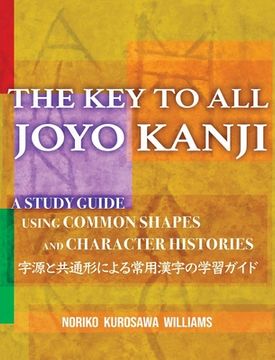
The Key to All Joyo Kanji: A Study Guide Using Common Shapes and Character Histories 共通形と字源に
Williams, Noriko Kurosawa
Synopsis "The Key to All Joyo Kanji: A Study Guide Using Common Shapes and Character Histories 共通形と字源に"
THE KEY TO ALL JOYO KANJI - A Study Guide Using Common Shapes and Character Histories (共通形と字源による常用漢字の学習ガイド)This book is a study guide/reference intended to make learning and remembering kanji more efficient by grouping kanji that share the same components among the 2,136 Japanese Joyo kanji (commonly-used kanji 常用漢字). Most kanji are comprised of recurring components. Wherever the same component appears, its core meaning and/or sound is the same or closely related to every other kanji that has the same component because they were derived from the same origins. This book explains those origins, going back to ancient times, and shows how they developed into present-day Japanese kanji. Within each common shape group, kanji are labeled with a level of difficulty - A (easiest) to D (most challenging). The reader can start (or start to review) with the easiest level and move to more complex kanji, while also reinforcing knowledge of previously learned kanji within the same common shape group. A detailed table of Kanji Common Shapes provides an overview of the 432 common components, noting their origins, meaning, related kanji, and suggested study level. Each group of kanji component shapes includes the following: COMMON SHAPE (432 SHAPES)Meaning, historical development, sound, and kanji containing the same shapeKANJI TABLE (2,136 KANJI)English core meaning, Kun and On reading, traditional bushu ("radical," 部首), full stroke order illustration, and total stroke numberFour suggested levels of kanji study, roughly corresponding to the five levels of the JLPT (Japanese Language Proficiency Test) - Level A (566 kanji) - Beginning level [JLPT N5 and N4]; Level B (525 kanji) - Intermediate through Pre-advanced [JLPT N3 and N4]; Level C (520 kanji) - Advanced I level [JLPT N1]; and Level D (525 kanji) - Advanced II level [JLPT N1].4,500 ancient characters (in oracle bone-style 甲骨文, bronzeware-style 金文, and seal-style 篆文) allowing the reader to visualize and grasp the development of the kanji.Succinct English accounts, linking its origin to present-day Japanese kanji.Several sample words and an accentual tonal fall marking in standard Japanese.For a reader to use the book as a reference, four indices are provided: Index 1 The Order of Kanji in the Book (by the Study Guide number) 導入順漢字リスト; Index 2 Kanji by On and Kun Reading in Japanese Syllabary Order 漢字の音訓読み五十音順リスト; Index 3 Kanji by Total Stroke Number 総画数による漢字表; and Index 4 Kanji by Bushu 部首による漢字表