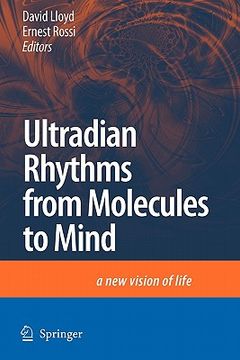
ultradian rhythms from molecules to mind: a new vision of life
David Lloyd
Synopsis "ultradian rhythms from molecules to mind: a new vision of life"
5. 1. 1 Biological Rhythms and Clocks From an evolutionary perspective, the adaptation of an organism's behavior to its environment has depended on one of life's fundamental traits: biological rhythm generation. In virtually all light-sensitive organisms from cyanobacteria to humans, biological clocks adapt cyclic physiology to geophysical time with time-keeping properties in the circadian (24 h), ultradian (24 h) domains (Edmunds, 1988; Lloyd, 1998; Lloyd et al., 2001; Lloyd and Murray, 2006; Lloyd, 2007; Pittendrigh, 1993; Sweeney and Hastings, 1960) By definition, all rhythms exhibit regular periodicities since they constitute a mechanism of timing. Timing exerted by oscillatory mechanisms are found throughout the biological world and their periods span a wide range from milliseconds, as in the action potential of n- rons and the myocytes, to the slow evolutionary changes that require thousands of generations. In this context, to understand the synchronization of a population of coupled oscillators is an important problem for the dynamics of physiology in living systems (Aon et al., 2007a, b; Kuramoto, 1984; Strogatz, 2003; Winfree, 1967). Circadian rhythms, the most intensively studied, are devoted to measuring daily 24 h cycles. A variety of physiological processes in a wide range of eukaryotic organisms display circadian rhythmicity which is characterized by the following major properties (Anderson et al., 1985; Edmunds, 1988): (i) stable, autonomous (self-sustaining) oscillations having a free-running period under constant envir- mental conditions of ca.
David Lloyd, nacido en 1950 en Enfield, Londres, es uno de los artistas británicos más influyentes del cómic moderno. Comenzó su carrera a finales de los años setenta, colaborando con diversas revistas y antologías de terror y aventuras, donde desarrolló un estilo visual oscuro, expresivo y profundamente cinematográfico que más tarde se convertiría en su sello personal.
Durante sus primeros años trabajó para publicaciones británicas y para Marvel UK, ilustrando historias de misterio, crimen y ciencia ficción. Su consagración llegó al unirse al guionista Alan Moore para crear V for Vendetta, una obra distópica ambientada en una Inglaterra totalitaria. Lloyd no solo aportó el aspecto visual de la serie, sino que también diseñó la icónica máscara de Guy Fawkes, un elemento que trascendería la historieta para convertirse en símbolo cultural y político alrededor del mundo.
Tras el éxito de V for Vendetta, Lloyd continuó colaborando con editoriales internacionales en títulos como Night Raven, Hellblazer y diversos proyectos autorales. Su estilo destaca por el uso dramático del claroscuro, composiciones sobrias y una aproximación realista que enfatiza la tensión emocional de cada escena.
En años recientes, Lloyd impulsó Aces Weekly, una antología digital que reúne a artistas de múltiples países, promoviendo nuevas formas de publicar y distribuir cómic en la era digital.