你好! Shipping to Taiwan with premium packaging for just NT$300 

Ship to
Taiwan
0
  • argentina
  • chile
  • colombia
  • españa
  • méxico
  • perú
  • estados unidos
  • internacional

Select your country

Americas

Europe

Rest of the world

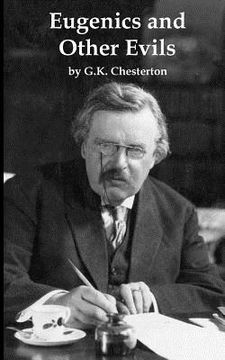
portada Eugenics and Other Evils
Type
Physical Book
Publisher
Language
English
Pages
164
Format
Paperback
Dimensions
20.3x12.7x0.9 cm
Weight
0.17 kg.
ISBN13
9781522965794

Eugenics and Other Evils

G. K. Chesterton (Author) · Createspace · Paperback

Eugenics and Other Evils - G. K. Chesterton

New Book Imported to Taiwan
Delivery: 20 Oct - 02 Nov Shipping: 17 to 21 business days.
NT$ 704
NT$ 704

Synopsis "Eugenics and Other Evils"

G.K. Chesterton's essays on Eugenics and Other Evils. - I publish these essays at the present time for a particular reason connected with the present situation; a reason which I should like briefly to emphasise and make clear. Though most of the conclusions, especially towards the end, are conceived with reference to recent events, the actual bulk of preliminary notes about the science of Eugenics were written before the war. It was a time when this theme was the topic of the hour; when eugenic babies (not visibly very distinguishable from other babies) sprawled all over the illustrated papers; when the evolutionary fancy of Nietzsche was the new cry among the intellectuals; and when Mr. Bernard Shaw and others were considering the idea that to breed a man like a cart-horse was the true way to attain that higher civilisation, of intellectual magnanimity and sympathetic insight, which may be found in cart-horses. It may therefore appear that I took the opinion too controversially, and it seems to me that I sometimes took it too seriously. But the criticism of Eugenics soon expanded of itself into a more general criticism of a modern craze for scientific officialism and strict social organisation. And then the hour came when I felt, not without relief, that I might well fling all my notes into the fire. The fire was a very big one, and was burning up bigger things than such pedantic quackeries. And, anyhow, the issue itself was being settled in a very different style. Scientific officialism and organisation in the State which had specialised in them, had gone to war with the older culture of Christendom. Either Prussianism would win and the protest would be hopeless, or Prussianism would lose and the protest would be needless. As the war advanced from poison gas to piracy against neutrals, it grew more and more plain that the scientifically organised State was not increasing in popularity. Whatever happened, no Englishmen would ever again go nosing round the stinks of that low laboratory. So I thought all I had written irrelevant, and put it out of my mind. I am greatly grieved to say that it is not irrelevant. It has gradually grown apparent, to my astounded gaze, that the ruling classes in England are still proceeding on the assumption that Prussia is a pattern for the whole world. If parts of my book are nearly nine years old, most of their principles and proceedings are a great deal older. They can offer us nothing but the same stuffy science, the same bullying bureaucracy and the same terrorism by tenth-rate professors that have led the German Empire to its recent conspicuous triumph. For that reason, three years after the war with Prussia, I collect and publish these papers.
G. K. Chesterton
  (Author)
View Author's Page
G. K. Chesterton (London, May 29, 1874 – Beaconsfield, June 14, 1936) was a prolific British writer, author of essays, novels, poetry, biographies, and Christian apologetics. His work is characterized by irony, paradoxical wit, and a critical view of modernity. He was a prominent convert to Catholicism and an influential figure in religious and literary thought of his time. He is also known for his brilliant argumentative style and his defense of common sense.

Among his most recognized works are The Man Who Was Thursday (1908), Orthodoxy (1908), The Innocence of Father Brown (1911), Heretics (1905), The Ball and the Cross (1909), and The Resurrection of Rome (1930). He cultivated the essay, the novel of ideas, detective stories, and social and religious criticism.
See more
See less

Customers reviews

Frequently Asked Questions about the Book

All books in our catalog are Original.
The book is written in English.
The binding of this edition is Paperback.

Questions and Answers about the Book

Do you have a question about the book? Login to be able to add your own question.

Opinions about Bookdelivery

More customer reviews