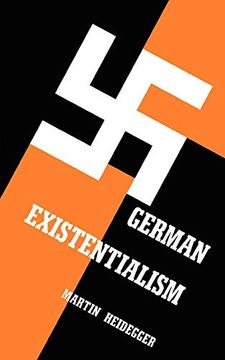
"On the day of German Labor, on the day of the Community of the People, the Rector of Freiburg University, Dr. Marin Heidegger, made his official entry into the National Socialist Party." And so begins one of the most controversial philosophical texts available today. Heidegger, a German Nationalist and proud Nazi, thoroughly examines the history, the philosophy, and the rise to power of the Nazi movement in Germany. Martin Heidegger's distinguished Italian colleague, Professor Benedetto Croce, said of his German contemporary, "This man dishonors philosophy and that is an evil for politics too." Croce's severe rebuke was not singular at the time when Hitlerism was rampant over Europe. It is true that among the almost one thousand professional philosophers of Germany and Austria only very few actively opposed National Socialism. On the other hand, no one degraded his historic profession in the manner Heidegger did, by becoming a spokesman for National Socialism and attempting to mold his theories into one pattern with Hitlerism. Heidegger's contribution to the growth and development of National Socialism was immense. In this small anthology Dr. Runes endeavors to point to the utter confusion Heidegger created by drawing, for political and social application of his own existentialism metaphysics, upon the decadent and repulsive brutalization of Hitlerism. Martin Heidegger was a philosopher most known for his contributions to German phenomenological and existential thought. Heidegger was born in rural Messkirch in 1889 to Catholic parents. While studying philosophy and mathematics at Albert-Ludwig University in Freiburg, Heidegger became the assistant for philosopher Edmund Husserl. Influenced by Husserl, Kierkegaard, and Nietzsche, Heidegger wrote extensively on the quality of Being, including his opus Being and Time. He served as professor of philosophy at Albert-Ludwig University and taught there during the war. In 1933, Heidegger joined the National Socialist German Worker's (or Nazi) Party and expressed his support for Hitler in several articles and speeches. After the war, his support for the Nazi party came under attack, and he was tried as a sympathizer. He was able to return to Albert-Ludwig University, however, and taught there until he retired. Heidegger continued to lecture and write until his death 1973.
Martin Heidegger (1889-1976). Filósofo alemán. Nació en Messkirch, Baden (Alemania), el 26 de septiembre de 1889. Su padre, Friedrich Heidegger (1851-1924) es sacristán católico y maestro tonelero, su madre es Johanna Heidegger, de soltera, Kemp (1858-1927). Cursó sus estudios de teología católica y después filosofía occidental en la Universidad de Friburgo, donde fue alumno de Edmund Husserl, el fundador de la fenomenología. Ya en el año 1915 comenzó a ejercer como profesor en Friburgo. Tras impartir clases durante cinco años en Marburgo, llegó a ser profesor de filosofía en Friburgo en 1928. En 1933 le nombran rector de la universidad de Friburgo y se afilia al partido nacionalsocialista (NSDAP). renuncia la prelusión rectoral sobre Autoafirmación de la Universidad alemana. Organización del campamento de la ciencia. Apariciones propagandísticas en Leipzig, Heildelberg y Tubinga. Colaborador en la reforma de la universidad de Baden (introducción de principio del caudillaje). Renuncia al rectorado al año siguiente por discrepancias con el gobierno y deja de ocuparse de política. Comienza un periodo de casi absoluto silencio: Heidegger no publicará casi nada hasta 1942. En cambio dicta regularmente sus cursos académicos. Falleció en Messkirch el 26 de mayo de 1976.