你好! Shipping to Taiwan with premium packaging for just NT$300 

Ship to
Taiwan
0
  • argentina
  • chile
  • colombia
  • españa
  • méxico
  • perú
  • estados unidos
  • internacional

Select your country

Americas

Europe

Rest of the world

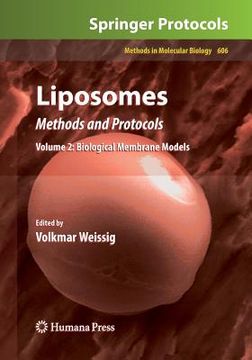
portada liposomes: methods and protocols, volume 2: biological membrane models
Type
Physical Book
Illustrated by
Publisher
Year
2012
Language
English
Pages
548
Format
Paperback
Dimensions
25.4x17.8x2.9 cm
Weight
0.97 kg.
ISBN
1617796875
ISBN13
9781617796876

liposomes: methods and protocols, volume 2: biological membrane models

Volkmar Weissig (Illustrated by) · Humana · Paperback

liposomes: methods and protocols, volume 2: biological membrane models - Weissig, Volkmar

Cheaper New Book Imported to Taiwan
Delivery: 18 Nov - 01 Dec Shipping: 15 to 19 business days.
NT$ 3,642
Faster New Book Imported to Taiwan
Delivery: 05 Nov - 13 Nov Shipping: 6 to 7 business days.
NT$ 7,187
NT$ 3,642

Synopsis "liposomes: methods and protocols, volume 2: biological membrane models"

Efforts to describe and model the molecular structure of biological membranes go back to the beginning of the last century. In 1917, Langmuir described membranes as a layer of lipids one molecule thick [1]. Eight years later, Gorter and Grendel concluded from their studies that "the phospholipid molecules that formed the cell membrane were arranged in two layers to form a lipid bilayer" [2]. Danielli and Robertson proposed, in 1935, a model in which the bilayer of lipids is sequestered between two monolayers of unfolded proteins [3], and the currently still accepted fuid mosaic model was proposed by Singer and Nicolson in 1972 [4]. Among those landmarks of biomembrane history, a serendipitous observation made by Alex Bangham during the early 1960s deserves undoubtedly a special place. His fnding that exposure of dry phospholipids to an excess of water gives rise to lamellar structures [5] has opened versatile experimental access to studying the biophysics and biochemistry of biological phospholipid membranes. Although during the following 4 decades biological membrane models have grown in complexity and functionality [6], liposomes are, besides supported bilayers, membrane nanodiscs, and hybrid membranes, still an indisputably important tool for membrane b- physicists and biochemists. In vol. II of this book, the reader will fnd detailed methods for the use of liposomes in studying a variety of biochemical and biophysical membrane phenomena concomitant with chapters describing a great palette of state-of-the-art analytical technologies.

Customers reviews

Frequently Asked Questions about the Book

All books in our catalog are Original.
The book is written in English.
The binding of this edition is Paperback.

Questions and Answers about the Book

Do you have a question about the book? Login to be able to add your own question.

Opinions about Bookdelivery

More customer reviews